Home / Repairs
Render and stucco repairs in London
Cracked, hollow, stained or falling off. We work out why it failed, cut out what has gone and repair it so the fault does not come straight back.
What people call us about
Cracks
Cracks running from window corners, along the line of a lintel or straight up a wall where an extension meets the house.
Hollow and blown patches
Areas that sound drummy when tapped, bulge outward or have already dropped onto the patio.
Damaged stucco
Flaking, patched and mismatched stucco on period fronts, with cornices and surrounds that have lost their edges.
Parapets and chimneys
The most exposed render on the building and usually the first to fail. Often the hidden cause of damp in a top-floor room.
Damage after new windows
Broken reveals and ragged edges left behind when frames were swapped. Made good and blended in.
Stains and green growth
Streaks under sills and algae on shaded walls. Sometimes a clean is enough. Sometimes it points to water getting somewhere it should not.
Why render fails
Render rarely fails because of the coat you can see. The usual causes are underneath or above it.
- Water getting in behind from a gutter, coping or cracked sill
- Hard cement render on a soft, solid wall that needed to breathe
- No mesh across the corners of openings
- Coats applied too thin, too fast or in frost
- New work joined to old with no movement joint
- Render taken down to the ground and bridging the damp course
Fix the cause and the repair lasts. Skip it and you will be paying for the same patch again.

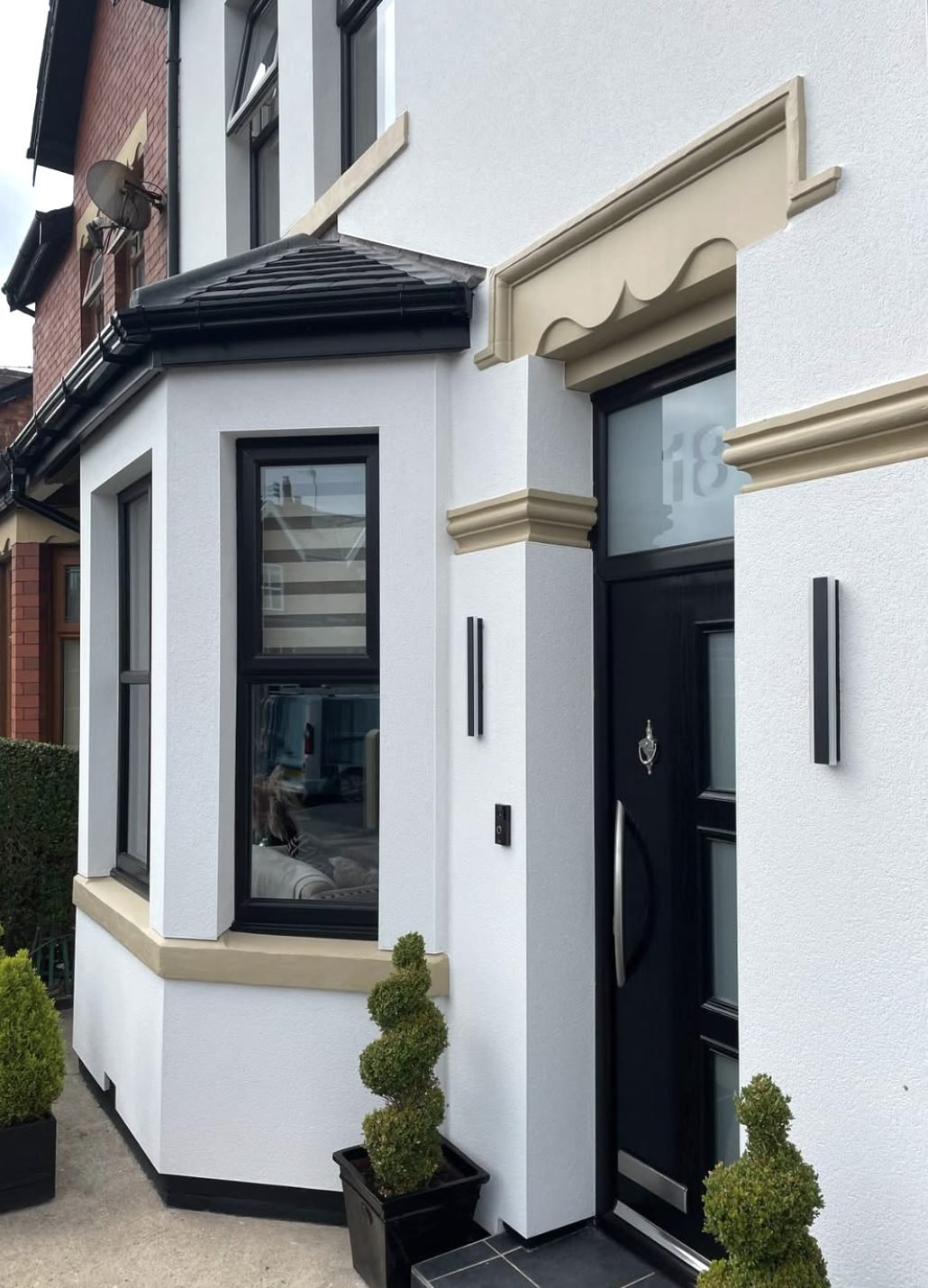
Stucco on period houses
London's stucco streets were built with lime, then patched through the last century with cement. The two do not get on. Cement is harder and less porous than the wall behind it, so water that gets in cannot get out, and the patch eventually pushes off, taking good stucco with it.
We repair in materials that suit what is already there, keep as much sound original work as possible and re-form the details by hand: band courses, door surrounds, rustication lines and bay mouldings.
Repair or re-render?
As a rule of thumb, if more than about a third of an elevation is hollow, patching stops making sense. You end up with a wall of joins. We will show you the tapped-out areas marked on the wall and give you both prices where it is a close call.
Questions about repairs
Can a crack in render just be filled?
A fine hairline crack in sound render sometimes can. A wider crack, or one that keeps coming back, means something is moving or water is getting behind, and filler will open up again within a winter. We check what is behind it first.
What does it mean when render sounds hollow?
It has come away from the wall behind. It may stay up for years or come off in the next frost. Hollow areas are cut out back to a firm edge and redone, because nothing bonds properly to a coat that is no longer attached.
Will a patch repair show?
A patch in painted render can be made very hard to spot once the wall is repainted. Through-coloured finishes are harder to blend, because the old surface has weathered. Where a patch would show, we will say so and price the full panel or elevation as an alternative.
Can you repair original stucco and mouldings?
Yes. Flat areas are repaired in a compatible lime mix, and cornices, string courses and window surrounds are re-run or rebuilt to follow the existing profile. On listed buildings and in conservation areas, like-for-like repair is normally what the council expects.
My wall is damp inside. Will re-rendering fix it?
Only if failed render is the cause. Damp in London houses just as often comes from a leaking gutter, a failed parapet, a bridged damp course or raised ground outside. We look for the source and tell you honestly if a renderer is not who you need.
Describe the damage
Where it is on the house and how long it has been like that is a good start.
Worried about a crack or a loose patch?
Ring and describe it. If it sounds urgent we will say so.